AUTHENTIC SHIRTING & KURTA FABRICS
How to Buy Fabric in Bulk Directly from a Manufacturer in India
To buy fabric in bulk directly from a manufacturer in India, define your garment and fabric specifications first (composition, GSM, width, finish), shortlist manufacturers whose product range matches, approve a sample, confirm minimum order quantity, price, payment terms and delivery timelines in writing, and then place the order with clear documentation. Choosing a manufacturer takes more than comparing rates; consistency, communication and specification clarity matter just as much.
Buying directly can help garment makers, clothing brands and wholesalers because they speak to the source of supply about specifications and repeat requirements. Whether it suits you depends on your order volume, the fabric you need and what the manufacturer can actually offer. This guide walks through the process, the checks, the common mistakes and the regional sourcing context for Mumbai, Bhiwandi and the rest of India.
Why Businesses Buy Fabric Directly from Manufacturers
Direct sourcing is not automatically cheaper, and a good buyer does not assume it is. The real advantages are usually about clarity and control:
- Knowing the source. You deal with the business that actually makes or finishes the fabric, so questions about construction, finish or batch behaviour reach the right people.
- Better specification discussions. Composition, GSM, width and texture can be discussed without layers of intermediaries.
- Product selection. A manufacturer can show its full range for a category, which helps when you are choosing between similar constructions.
- Potential supply consistency. Repeat orders from one source can reduce variation, although batch-to-batch differences still need to be checked.
- Visibility and relationship. Over time, a direct relationship makes it easier to plan repeat orders, discuss delivery and resolve issues.
Who Should Buy Fabric Directly from a Manufacturer?
Direct sourcing makes the most sense when your requirement is repeatable and specification-driven.
| Business type | When direct sourcing makes sense |
|---|---|
| Garment manufacturers | Regular production runs where fabric consistency affects cutting and stitching. |
| Kurta manufacturers | Seasonal and festive collections that need dependable fabric availability and consistent shades. |
| Clothing brands and fashion labels | Collections built around a specific fabric look, feel or print. |
| Wholesalers and fabric traders | Volume buying where range, specification clarity and repeat supply matter. |
| Boutiques and apparel startups | Smaller or growing requirements. Check the manufacturer's order requirements first, as they vary. |
| Apparel production units | Ongoing programmes where documentation and repeat-order planning save time. |
If your quantities are very small or varied, a wholesaler may be more practical. The right choice depends on what each source can offer you.
Recent Post
Step-by-Step Guide to Buying Fabric in Bulk
- Define the garment or application. Kurtas, shirts and printed apparel each need different fabric behaviour.
- Identify fabric type and composition. For example cotton, linen-cotton blend or polycotton.
- Set specifications. GSM, width, texture and finish, wherever applicable.
- Estimate your requirement. Use garment size, width, wastage and shrinkage (see the quantity section below).
- Research and shortlist manufacturers. Match their product range to your fabric type.
- Request and review samples, if available. Do not assume samples are free or always offered; ask.
- Ask about minimum order requirements. Get this in writing, per fabric.
- Confirm specifications and expectations. Record composition, GSM, width, colour and finish against the approved sample.
- Discuss price, payment terms and timelines. Compare on a like-for-like specification, not on headline rate alone.
- Confirm order details before proceeding. Quantity, specification, delivery date and payment terms in one written confirmation.
- Understand quality checks and delivery arrangements. Ask how fabric is checked and how it will be transported.
- Keep documentation for repeat orders. Save approved samples, specifications and correspondence.
What Should You Check Before Selecting a Bulk Fabric Manufacturer?
Use this checklist to compare manufacturers on the same footing.
| Check | What to ask | Why it matters |
|---|---|---|
| Product range | Which fabrics do you make for my garment type? | Avoids mismatch between need and supply. |
| Manufacturing or sourcing capability | Do you make the fabric, or source part of it? | Clarifies who is accountable for quality. |
| Fabric quality | Can I see the fabric before ordering? | Appearance and feel are hard to judge from photos. |
| Composition | What is the exact fibre blend? | Affects comfort, care and garment behaviour. |
| GSM | What is the GSM of this fabric? | Determines weight, drape and fabric usage. |
| Width | What is the usable width? | Changes how much fabric you need per garment. |
| Colour consistency | How is shade consistency managed across lots? | Prevents visible variation within a garment run. |
| Finishing | What finish has been applied? | Influences hand feel and stitching. |
| Sample availability | Do you provide samples, and on what terms? | Allows approval before bulk commitment. |
| Bulk order capability and MOQ | What quantity do you need, and what can you supply? | Confirms the order fits both sides. |
| Communication | Who will I deal with, and how quickly are queries answered? | Smooth communication reduces order errors. |
| Delivery expectations | What are the typical timelines and transport options? | Protects your production schedule. |
| Quality control practices | How is fabric checked before dispatch? | Sets expectations on defects and rejections. |
| Transparency of specifications | Will specifications be confirmed in writing? | Gives you a reference for repeat orders. |
Which Fabric Specifications Should Buyers Confirm Before Ordering?
Non-technical buyers can handle specifications by confirming these in plain terms:
- Composition: What fibres the fabric is made of, such as cotton, linen or polyester, and in what proportion.
- GSM (grams per square metre): A measure of fabric weight. Higher GSM generally means a heavier fabric.
- Width: The usable width of the fabric, which affects cutting and fabric usage.
- Weave or construction: How the yarns are interlaced, which shapes strength, texture and drape.
- Colour, print or design: The shade or pattern, ideally matched against an approved sample.
- Texture and finish: How the fabric feels and what treatment it has received.
- Shrinkage considerations: Ask whether shrinkage is a factor for this fabric and how to account for it in cutting.
- Intended end use: Tell the manufacturer the garment type so the fabric suggested actually suits it.
Why Fabric Samples Matter Before a Bulk Purchase
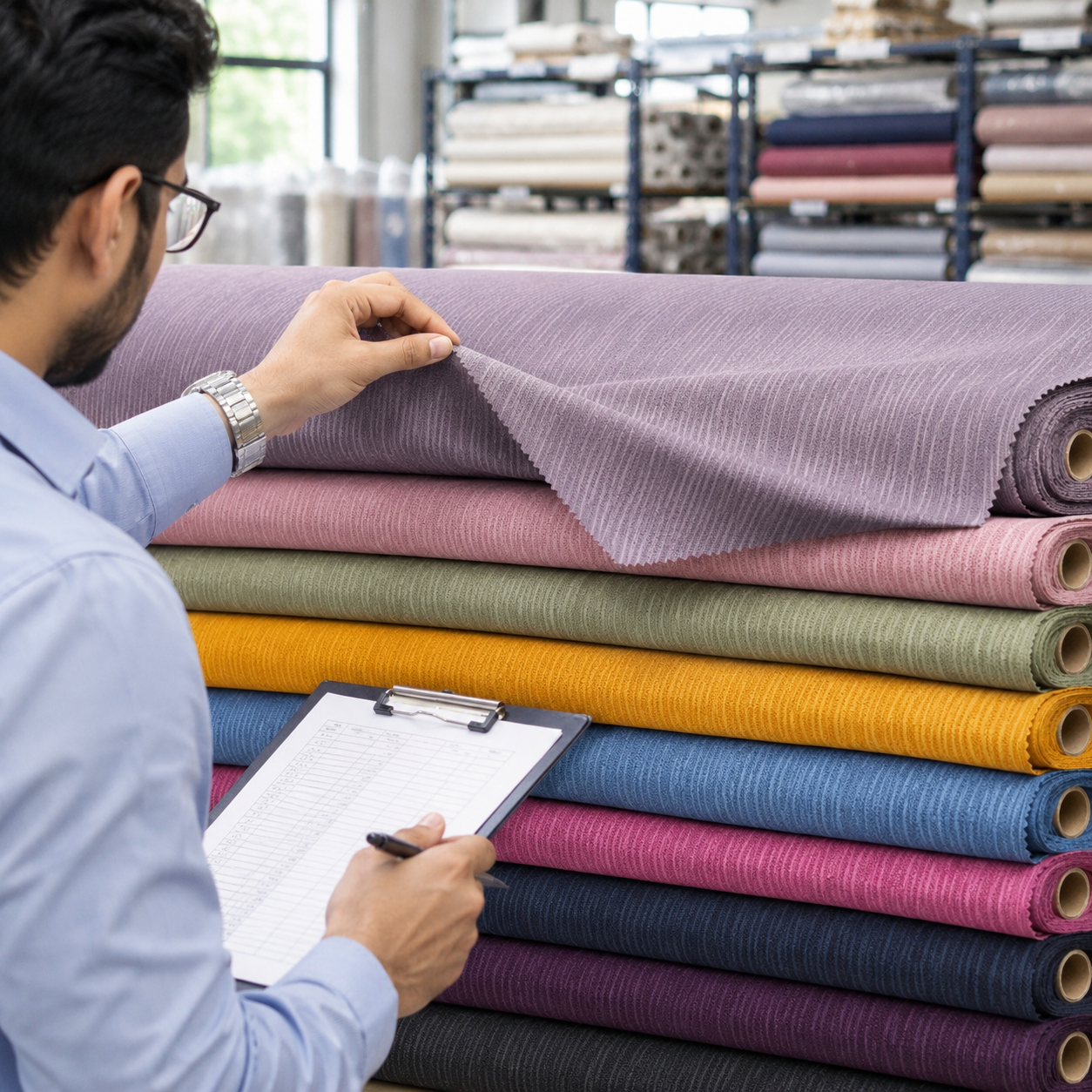
A sample lets you check what specifications cannot fully describe: texture, appearance, colour and the feel of the fabric. It also lets you test suitability for your garment (for instance, how a kurta fabric drapes or how a shirting fabric handles stitching) and compare the fabric against the specifications you were given. Sample policies differ between manufacturers, so ask whether samples are available and on what terms, rather than assuming they are free.
How to Estimate Fabric Quantity for Bulk Garment Production
Fabric requirement depends on garment design, size range, fabric width, cutting layout, wastage, shrinkage allowance and total production quantity. A wider fabric or a better cutting layout can reduce the fabric needed per garment, while a printed or directional fabric may raise wastage.
Illustrative example only (not a universal consumption figure): Assume a kurta pattern needs 2.5 metres per piece at a given width. For 500 pieces, the base requirement is 1,250 metres. With an assumed 5% allowance for wastage and shrinkage, you would plan for roughly 1,312 metres. Your own pattern, width and cutting plan will give different numbers, so confirm with your pattern master.
Buying Fabric from Manufacturers in Mumbai and Bhiwandi
Bhiwandi is widely regarded as a textile hub close to Mumbai, with many fabric manufacturers and textile warehouses. For buyers across the Mumbai Metropolitan Region, that proximity can make sourcing easier to manage.
A garment unit in Mumbai or Thane can arrange sample collection, specification discussions and follow-up without long lead times. Buyers in Navi Mumbai, Kalyan-Dombivli, Vasai-Virar, Mira Road and Panvel can often coordinate transport and repeat orders within the same regional network. When comparing a fabric manufacturer in Mumbai with one in Bhiwandi, look at:
- How easy it is to review samples in person or through courier;
- Order requirements and product suitability for your garment;
- Transport coordination to your unit or warehouse;
- How well the supplier supports repeat-order planning.
Sai Krupa Synthetics is based in Bhiwandi. Buyers can explore its range and contact the team about their requirement through the contact page.
Fabric Sourcing for Businesses Across Maharashtra and India
Businesses in Pune, Nashik, Ahmedabad, Surat, Jaipur, Delhi NCR, Bengaluru, Chennai and Hyderabad can also evaluate manufacturers based elsewhere. The approach is the same wherever you are: get a physical sample approved before bulk commitment, confirm specifications in writing, agree communication channels, plan logistics early, set quality expectations and keep records for repeat orders. Delivery coverage should always be confirmed directly with the manufacturer.
Common Mistakes to Avoid When Buying Fabric in Bulk
- Ordering only on price, without comparing like-for-like specifications.
- Not checking composition, GSM or fabric specifications.
- Skipping sample approval.
- Not confirming width or GSM in writing.
- Not clarifying minimum order quantity.
- Ignoring colour variation between lots.
- Not discussing delivery timelines.
- Not keeping order documentation.
- Assuming the same fabric will be identical from one batch to the next.
Why Work with a Fabric Manufacturer for Your Business Requirements?
A manufacturer relationship can offer closer communication on specifications, a clearer view of the product range and easier repeat-order planning. It does not remove the need to evaluate: compare quality, responsiveness, delivery reliability and order terms before committing. Treat the first order as a test of the relationship.
Fabric Products Available at Sai Krupa Synthetics
Sai Krupa Synthetics is a Bhiwandi-based fabric manufacturer. Its range includes:
- Ethnic kurta fabrics for kurta and ethnic wear production.
- Linen/cotton blended shirting fabrics for shirt manufacturers and brands.
- Digital print fabrics for printed apparel requirements.
You can browse the full range on the Sai Krupa Synthetics website. For background on sourcing in the region, see our guide to choosing a fabric manufacturer in Bhiwandi.
Some Important FAQ's
How can I buy fabric directly from a manufacturer in India?
A: Define your fabric specifications, shortlist manufacturers whose range matches, request samples, confirm MOQ, price and delivery terms in writing, and then place your order.
Have Any Questions
A: Not always. Direct buying offers closer specification discussions and a clearer source, while wholesalers may suit smaller or mixed quantities. Compare on your own volume and needs.
A: It varies by manufacturer and by fabric. Ask for the MOQ for the specific fabric you want, and get it confirmed in writing.
A: You can ask. Sample policies differ, so confirm whether samples are available and on what terms.
A: Composition, GSM, width, weave, colour or print, texture, finish, shrinkage considerations and intended end use.