AUTHENTIC SHIRTING & KURTA FABRICS
The Complete Guide to PolyCotton Fabric: Science, Properties & Manufacturing
Introduction: Understanding PolyCotton Beyond Basics
PolyCotton isn’t just a fabric blend it’s a textile innovation born out of necessity and perfected by technology. While beginners may know it simply as a mix of polyester and cotton, advanced users appreciate the science and engineering that go into achieving the perfect balance between comfort, strength, and functionality. Think of PolyCotton as a hybrid material where nature and technology meet to create something greater than the sum of its parts.
This fabric isn’t static; it evolves with manufacturing innovations, eco-friendly practices, and smart textile integration. Whether used for high-performance uniforms, luxury bedding, or heat-regulating apparel, PolyCotton has redefined textile durability and versatility. For advanced users, understanding this material means going beyond “what it is” and exploring “how it works” and “why it performs.”
The Science Behind PolyCotton: Fiber Fusion Explained
To truly appreciate PolyCotton, one must dive into the molecular harmony between natural cotton fibers and synthetic polyester filaments. Cotton, a cellulose-based natural fiber, offers comfort, breathability, and moisture absorption. Polyester, a man-made polymer derived from petroleum, contributes strength, wrinkle resistance, and shape retention. When blended, they form a fabric that carries the softness of cotton with the endurance of polyester a perfect symbiosis.
At the molecular level, cotton fibers have a hollow, twisted ribbon-like structure that allows air and moisture to move through freely. Polyester, on the other hand, has a smooth, uniform surface that resists absorption. When these fibers intertwine through advanced spinning techniques, the resulting yarn provides controlled moisture wicking absorbing sweat on one side and evaporating it through the other. This engineered balance is what makes PolyCotton perfect for performance clothing, uniforms, and bedding.
The weave or knit used during production also changes everything. For instance, a tightly woven 65/35 PolyCotton blend is often used for uniforms where durability is essential, while a lighter 50/50 knit is favored for casual wear, offering flexibility and breathability. Understanding this micro-level fusion empowers designers and textile engineers to customize performance outcomes precisely to the product’s purpose.
The Evolution of PolyCotton: From Utility to Innovation
PolyCotton’s story is rooted in the industrial textile revolution. Originally developed as a cost-effective solution to the limitations of pure cotton, the blend rapidly became the standard for functional fabrics. During the 1950s and 60s, manufacturers sought ways to reduce ironing and shrinkage while maintaining the comfort of natural fibers. The solution? Blend polyester with cotton to create an easy-care textile that could endure rigorous use.
Recent Post
Fast-forward to today, and PolyCotton has evolved far beyond practicality. It’s now engineered with nanotechnology for antimicrobial protection, UV resistance, and even odor control. In the world of advanced textiles, PolyCotton is no longer just an economical choice it’s a high-performance material tailored for diverse applications, from medical uniforms to smart fabrics integrated with wearable technology.
Modern innovations also address sustainability challenges. Many manufacturers are now using recycled polyester and organic cotton to produce eco-friendly PolyCotton blends, significantly reducing environmental impact. This balance of technology and responsibility has allowed PolyCotton to remain a staple in both commercial and luxury markets.
Key Properties of PolyCotton Fabric
PolyCotton is not just known for its affordability it’s valued for its multidimensional performance. Let’s explore its core characteristics in depth:
- Durability: Polyester fibers add immense strength, ensuring the fabric withstands friction, washing, and repeated wear without losing shape or color. This makes PolyCotton ideal for uniforms and outdoor apparel.
- Breathability: Cotton contributes natural airflow and moisture control, preventing overheating. The combination ensures comfort across diverse climates.
- Wrinkle Resistance: Unlike 100% cotton, PolyCotton resists creasing, meaning garments remain fresh-looking even after long hours of use.
- Moisture Management: The cotton component absorbs sweat, while polyester helps it evaporate quickly, ensuring the skin stays dry.
- Shrink and Fade Resistance: Polyester’s dimensional stability prevents shrinking and fading, allowing garments to retain their fit and vibrancy longer.
- Easy Maintenance: PolyCotton can be machine-washed, tumble-dried, and ironed on low heat no special care required.
For advanced users, these properties make PolyCotton a top choice where performance and comfort must coexist. Whether in industrial uniforms, medical scrubs, or bedding, the fabric’s resilience ensures long-term reliability.
Advanced Manufacturing Techniques
Creating PolyCotton isn’t as simple as mixing two fibers. Advanced textile engineering involves precision in blending, spinning, and finishing.
- Blending Ratios: The most common ratios 65% polyester and 35% cotton or a balanced 50/50 are chosen depending on performance goals. A higher polyester ratio enhances strength and wrinkle resistance, while more cotton improves softness and moisture control.
- Spinning Technology: Open-end and ring-spun methods determine the fabric’s texture and feel. Ring-spun PolyCotton yields a smoother, more durable yarn used in premium apparel.
- Finishing Treatments: Post-weaving processes like anti-pilling, flame-retardant, and stain-resistant finishes enhance the fabric’s functionality. For example, flame-retardant PolyCotton is used in industrial settings, while wrinkle-free finishes serve the hospitality industry.
This engineering precision ensures consistency in performance and comfort. High-quality PolyCotton fabrics undergo strict testing for tensile strength, shrinkage, and colorfastness ensuring they meet global textile standards.
Final Thoughts
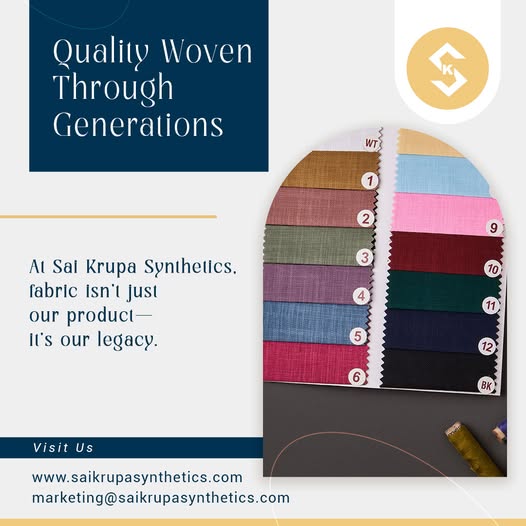
At Sai Krupa Synthetics, we specialize in producing premium PolyCotton fabrics engineered for durability, comfort, and performance. This two-part guide helps advanced users, apparel designers, and textile professionals understand the science and innovation behind our blended fabrics.
Looking for premium PolyCotton fabrics for garments or home textiles? Explore Sai Krupa Synthetics’ advanced fabric collection today!